
Uganda
Varying Compliance Seen on Second National Cleaning Day
The second National Cleaning Day in Kampala, Uganda, revealed inconsistent public involvement. While some communities participated voluntarily, security and local officials had to enforce compliance among others.
Published 29 Aug, 13:00 · Pearl Hundred newsroom
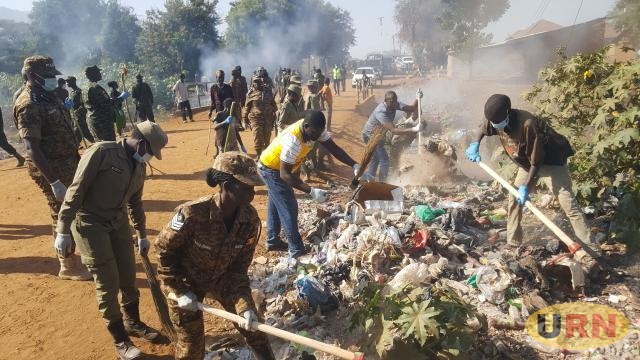
This three-hour cleanup initiative took place on Saturday, August 29, between 7:00 am and 10:00 am. It forms part of a government plan to institute monthly community cleanups, aiming to elevate sanitation and waste management standards. In several locations, law enforcement, military personnel, and local government officials halted individuals on roadways, mandated business closures, and instructed those remaining indoors to join the effort.
In Kiwoko Town Council, within Nakaseke District, Area Member of Parliament and Minister of State for Kampala Metropolitan Affairs, Kyofatogabye Kabuye, accompanied by police, visited homes following reports that some inhabitants were deliberately staying inside to avoid the exercise.
Those discovered at home were directed to leave and provided with brooms to participate. Robert Kampora, who chairs the LC1 in Kibizzi Zone, Kiwoko Town Council, explained that officials resorted to enforcement because some residents declined to contribute, leaving others to manage the cleanup for their neighborhoods.
Minister Kyofatogabye additionally instructed police and town council officials to shut down businesses whose proprietors had not adhered to the cleaning directive.
In a statement delivered in Luganda, Kyofatogabye instructed local leaders to ensure that residents complied with the activity.
In Wobulenzi Town Council, Luwero District, travelers who were not exempt from the cleanup were stopped and told to participate. Town council authorities also seized chapati stalls and cooking equipment found on roadsides, accusing their owners of failing to follow directives to clean their immediate vicinities.
Moses Ssebalamu, the LC3 Chairperson for Wobulenzi Town, stated that the confiscated items were taken to the town council offices, where their owners would need to account for their actions. In Luwero Town Council, State Minister for the Luwero Triangle, Alice Kaboyo, spearheaded the initiative and encouraged residents to support it. Differing from the initial cleanup, town councils throughout Luwero District engaged additional garbage trucks to guarantee the prompt removal of collected waste.
The councils also received donations of wheelbarrows, spades, and other cleaning tools from Cissy Mulondo, the State Minister for Finance in charge of General Duties. Conversely, in Masaka District and Masaka City, authorities largely depended on outreach and community engagement instead of coercion. Public address systems were utilized to mobilize residents, and civil servants were assigned to various zones and streets to coordinate and oversee the cleanup, ensuring proper disposal of waste.
Ronald Kasekende, the Chairperson of Nyendo-Mukungwe Division, mentioned that government employees joined residents in a community-driven effort. Ibrahim Kabugo, the Senior Assistant Secretary for Kyannamukaaka Sub-county, noted that security leaders were also involved and participated, arguing that their presence motivated residents to join.
Kabugo stated that the exercise also served to educate communities on household hygiene, emphasizing the importance of adequate latrines and bathrooms, and maintaining clean homes. In Kapchorwa District, participation was lower than during the previous event, resulting in several streets in Kapchorwa Municipality remaining littered.
While many residents cleaned their own properties, only a small number showed up to clean public areas. Motorcycle taxi operators and public transport drivers were among those who took part, with some being stopped by police and directed to join the cleanup. Sam Kusuro, a resident of Taxi Park Cell in Central Division, recounted that he eventually cleaned his home after waiting in vain for other residents to appear.
Ann Chelangat, the LC1 Chairperson of Sosio Cell, indicated that residents had received prior mobilization and instructions to ensure every household's involvement. At Kapchorwa Hospital, patient caregivers collaborated with healthcare workers to clean the hospital grounds.
However, the municipality continues to struggle with waste disposal due to insufficient space for waste management. Some municipal waste is deposited at Camp Swahili, near the hospital lagoon, an area surrounded by residents. In Kabale District, the initiative saw widespread acceptance, although some residents focused on cleaning public roads and streets while neglecting their own homes.
In Bungongi, Northern Division, Kabale Municipality, some residents were observed burning refuse rather than transporting it to designated disposal sites. Police officers were deployed to enforce compliance, and some motorists were stopped and questioned during the scheduled cleaning period. Nevertheless, tourism vehicles and cargo trucks with foreign license plates were permitted to move without hindrance.
In Moroto Municipality, joint security teams, including the UPDF, Police, Anti-Stock Theft Units, and local leaders, began their street cleanup around 7:00 am. Unlike the previous event, most residents remained at home, cleaning their compounds rather than participating in the cleaning of public spaces.
Security personnel intercepted pedestrians, cyclists, and motorists who were out during the exercise, requiring them to clean before continuing their journeys. Brig. Gen. Michael Walaka Hyeroba, the UPDF 3rd Division Commander, remarked that despite many residents not joining public area cleanups, maintaining cleanliness within households remained significant.
He urged communities to uphold hygiene and sanitation standards and to dedicate at least one day each month to general environmental cleanliness.
Written and edited by the Pearl Hundred newsroom.